


After more than a decade of reviewing hi-fi on my channel, I’ve always felt there was still something left on the table when it came to achieving the most natural, open sound possible—especially in a boxed speaker. With Allie, that realization was finally met. Without hesitation, I can say this is the most beautiful-sounding stand-mount speaker I’ve ever had the pleasure of listening to.
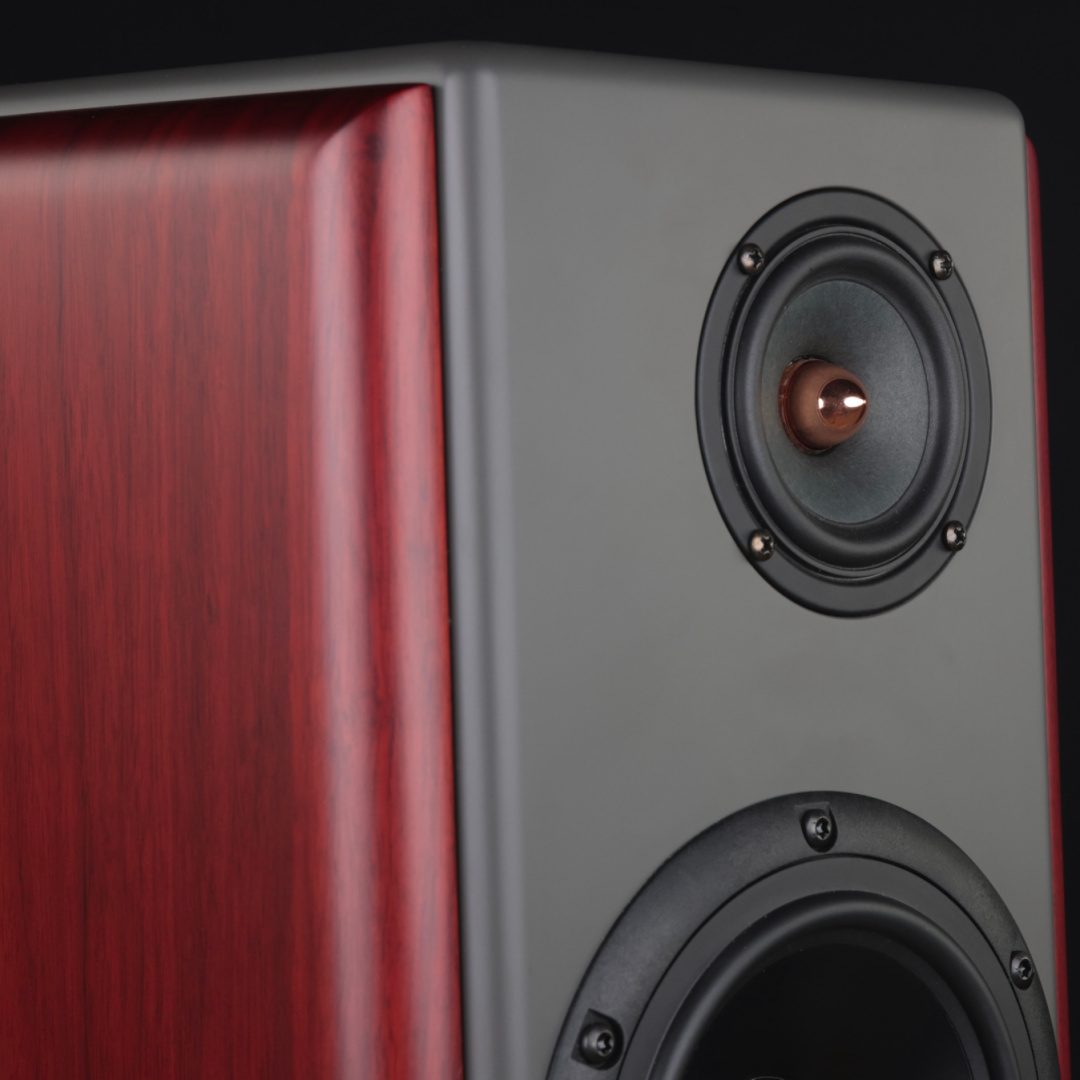
The Front Driver
At the heart of Allie is the LGK 2.0 wide-band driver, It handles the vast majority of the audible spectrum. By crossing it exceptionally low we avoid the typical crossover phase shifts. This design is time- and phase-coherent. The result is a balance that feels open, cohesive, and remarkably natural. Imaging is well focused and allows vocals and instruments to breathe and fill the room. .

The Woofer
Bass duties are handled by the M-130. It's a lightweight paper-cone woofer designed for speed, texture, and control. In this enclosure, it delivers solid bass extension to a -3db of 55Hz with clean texture. Notes start and stop with precision, free of overhang, giving bass lines real shape and tone rather than a blurred, one-note foundation.
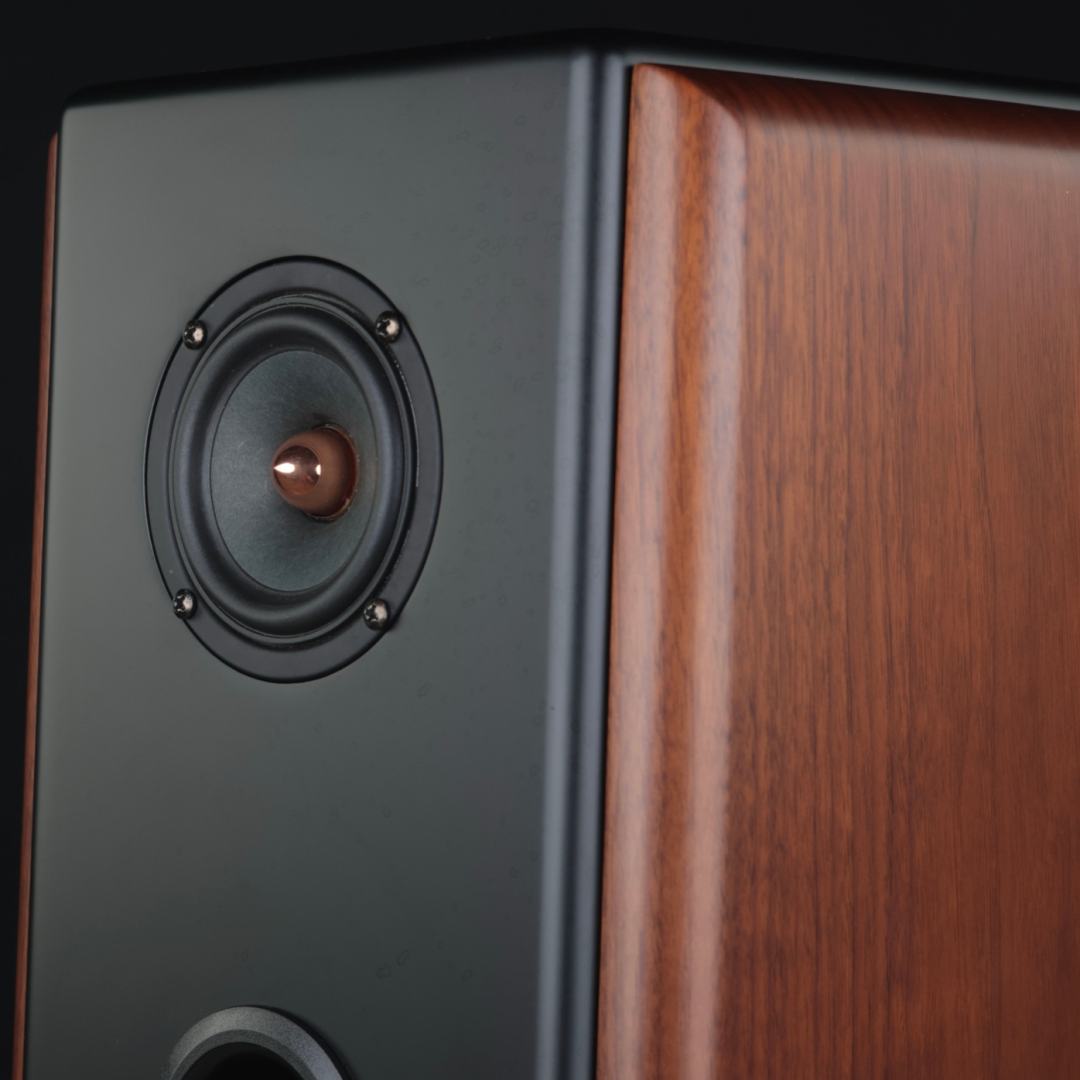
The Rear Driver
The rear-firing driver is Allie’s secret weapon, operating purely as an ambience channel. Rather than reinforcing direct sound, it introduces a delayed, low-level arrival that enhances spatial depth at the listening position. This approach creates a sense of openness reminiscent of open-baffle designs, expanding the soundstage without smearing focus or pulling attention away from the main presentation.

The Crossover
The crossover in Allie is where no compromises were made. Every component was selected for the best performance for its application and not its cost. There are no ferrous materials anywhere in the signal path. Only high-quality polypropylene capacitors and US made air-core inductors. We even had our own resistors made for these speakers. The wiring is four 9's pure Copper in polyethylene and treated with the Shunyata Research KPIP treatment. The result is a crossover that stays sonically invisible, preserving dynamics, tone, and coherence without imposing its own character on the music.

The Cabinet
With Allie, the focus was placed squarely on the music signal—and nothing else. The cabinet is extensively braced to eliminate the bloom and resonance commonly introduced by lightweight, under-built enclosures. Each speaker weighs over 32 pounds. Panel resonance is simply not part of the equation. The interior is further treated with No-Rez to damp out any remaining resonances and suppress internal reflections and standing waves. This prevents stored energy from blurring detail or disrupting timing. What remains is a quiet, inert structure that lets the drivers speak freely.
The Technology
Allie integrates advanced technologies developed by Caelin Gabriel of Shunyata Research. Every internal conductor undergoes Shunyata’s KPIP v2™ process. It is a four-day kinetic phase inversion treatment that refines the conductor material at an atomic level. This dramatically reduces burn-in time while contributing to a more relaxed and natural presentation. In addition, Shunyata’s HARP technology addresses audio-band current resonances by acting as a current-mode diffraction device, improving coherency and perceived resolution. Together, these technologies lower noise and allow Allie to reveal music with greater clarity and ease.
The audio samples below are microphone recordings of a loudspeaker (Allie) in a listening room and are provided for equipment evaluation and commentary only. They are not substitutes for the original recordings. Please support the artists by listening to the official releases.
Where There is Smoke
When
My Mind Is For Sale
The Pot
Gravity
Speaker Measurements | Frequency Response
The Allie model wasn't designed by numbers or measurements alone. The measurements were used only as a tool to quantify accuracy. We spent many hours listening, comparing components, and comparing room responses to balance the output from the front and rear drivers, creating the most realistic and involving presentation. The measurements also show only one aspect of the response at a time. One must consider the off axis responses and rear driver output that combine to create a more balanced overall in room response.

On axis Frequency Response
This measurement shows the 1-watt/1-meter frequency response taken at the height of the LGK wide-band driver. The LGK exhibits a small peak around 10 kHz. We evaluated the speaker both with and without a notch filter to flatten that peak and ultimately preferred the sound without the additional filtering. One reason is the natural off-axis behavior of a 3" wide-band driver. Compared to a typical tweeter, the top octave rolls off more quickly as you move off-axis. With the speakers aimed slightly away from the listener, that natural roll-off helps produce a very balanced in-room response.
Crossover Response
This graph shows the individual responses of the front-firing LGK wide-band driver and the lower M-130 woofer. The original design produced a more textbook flat on-axis response, but listening tests and in-room measurements led us to revise the crossover. One reflection that exists in virtually every listening environment is the floor-bounce reflection. In many two-way speakers this cancellation occurs in the 150–300 Hz region, and there is little that can be done about it. With this design, the crossover frequency falls within that range. We adjusted the crossover so the lower woofer operates slightly higher in frequency, increasing output in the region where the floor reflection typically reduces energy. As a result, the on-axis measurement appears mildly elevated through that band, but the in-room response is smoother and the perceived tonal balance is more natural.


The Rear Driver
This graph compares the on-axis response from the front of the speaker with the output measured behind the cabinet. The rear-facing LGK driver contributes additional rearward energy, creating a sense of spaciousness similar to what is often heard from open-baffle designs. In a typical listening room, the in-room response naturally tilts downward from bass to treble because higher frequencies are absorbed and scattered more readily by the room and furnishings. The rear-facing LGK helps restore some of that lost high-frequency energy into the room’s reverberant field. The result is a more open and lifelike presentation without altering the direct sound arriving at the listener.
Listening axis
The LGK 2.0 wide-band driver shows a small peak around 10 kHz when measured directly on-axis. Rather than removing it with a notch filter to produce a perfectly flat on-axis curve, it was intentionally left in place to achieve a more balanced in-room response. The speakers are designed to be listened to slightly off-axis, approximately 5 to 10 degrees. As shown in the measurement, the peak naturally decreases at those listening angles due to the directivity of the 3" driver. This does not result in a loss of high-frequency energy or a dull top end. In addition to the smoother off-axis response, the rear-facing driver contributes ambient energy in this region, helping maintain clarity while preserving a natural tonal balance

Horizontal | Vertical
A loudspeaker doesn’t exist on a test stand — it exists within the room. Because of that, how a speaker behaves off-axis can matter just as much as its on-axis response.
The horizontal measurements show a very smooth, controlled roll off as you move away from the center listening position. Instead of the sound changing character, it simply becomes quieter in a natural way. This helps preserve tonal balance throughout the room and allows reflections from your walls to reinforce the presentation rather than smear it. The result is a stable, believable soundstage and a center image that locks in place.
The vertical behavior is just as important, and this is where many designs struggle. With Allie, the response remains consistent whether you’re sitting, standing, or even listening from an unusual height. We’ve had the speakers sitting directly on the floor playing music and still maintained a solid center image at the listening position — something you rarely see from traditional multi-way designs.
In practice, this means Allie is far less sensitive to placement and seating height. You don’t have to be frozen in one exact chair to get the experience. The speaker works with the room instead of fighting it.

Horizontal Off Axis
The horizontal off-axis response is smooth and well controlled. Because the 3" LGK wide-band driver has a smaller radiating surface than larger full-range drivers, its off-axis response doesn't fall off dramatically. This means you don't have to aim them straight at you to hear the top octaves. It drops off more in a more controlled fashion than a typical dome tweeter minimizing side wall reflections in rooms with more limited treatment. The result is a controlled dispersion pattern that balances clear direct sound with a natural in-room presentation.
Vertical Off Axis
In many conventional two-way speakers, the woofer and tweeter are crossed over in the 2,000–3,000 Hz range. At that frequency range the wavelengths are short, so small changes in listening height place one driver slightly closer to the listener and the other slightly farther away. This difference in arrival time can produce phase rotation and vertical lobbing, causing the response to vary as you move above or below the listening axis. Allie uses a much lower crossover point of approximately 275 Hz. At this frequency the wavelengths are over four feet long, so typical changes in listening height create only a small phase shift between the drivers. As a result, vertical cancellations are greatly reduced and the tonal balance remains consistent over a wide range of listening heights.

Impedance | Stored Energy
Allie presents a friendly, real-world load to an amplifier. Rated at 6 ohms with an 87 dB sensitivity, it isn’t intended to be a flea-watt speaker, but it also doesn’t demand extreme power to come alive. In our listening we had excellent results with solid-state amplifiers in the double-digit watt range, and the speaker pairs especially well with tube amplification starting around 35 watts per channel. For more detailed pairing suggestions, be sure to visit the FAQ section.
The spectral decay measurement helps explain why Allie remains composed and easy to listen to over long sessions. The LGK wide-band driver has an extremely low moving mass — less than the weight of three paper clips. Because the cone is so light, it can start and stop very quickly, producing very little stored energy or ringing. Notes don’t linger after they should, and transients remain clean and believable rather than edgy or sharp.
Together, the controlled impedance behavior and clean decay mean Allie isn’t just compatible with a wide range of amplifiers — it stays relaxed, coherent, and non-fatiguing even as volume increases.

Impedance Curve
The impedance curve indicates an easy-to-drive load with minimal variation across the operating range, making the Allie compatible with a wide variety of amplifiers including tube, solid-state, and chip-based designs.The speaker maintains an average impedance above 6 ohms, with a minimum impedance of 4.88 ohms at 622 Hz. The impedance plot also identifies the port tuning frequency at approximately 54 Hz.
Spectral Decay

Frequently Asked Questions
Purchasing a loudspeaker doesn’t have to be confusing. Danny and I have worked to answer the most common questions we’ve received about Allie in the section below. If you still need help or don’t see your question listed, feel free to email info@gr-research.com and someone will get back to you as soon as possible.
Can Allie play extremely loud?
We’ve played Allie comfortably into the low to mid 90 dB range without audible issues. While the 3" wide-band driver and the small 5.25" woofer combination is exceptional at many things, it’s not a miracle worker when it comes to remodeling walls or shaking the clothes off your partner on demand. If extreme volume is what you’re after, speakers like the Brute or Bully may be a better fit. For listeners who spend most of their time in the 80s with dynamic swings into the 90s, Allie handles that territory with ease and composure.
What kind of amplifier pairs well with Allie?
We think Allie sounds great with your choice of either solid-state or tube amplifiers. Solid state typically reveals a bit more detail and grip, while tube amplification tends to sound sweeter and slightly softer.
Specifically, we’ve had great success with very affordable amplifiers like the Douk A5 at reasonable volume levels, and we absolutely love how Allie sounds when paired with the Miller Audio Dynaco ST-70.
Allie presents a friendly, real-world load to an amplifier. Rated at 6 ohms with an 87 dB sensitivity, it isn’t intended to be a flea-watt speaker, but it also doesn’t require extreme power to come alive. In our listening, solid-state amplifiers in the double-digit watt range performed very well, and the speaker pairs especially nicely with tube amplification starting around 35 watts per channel.
How About Speaker Placement?
Our preferred method for dialing in Allie is using LOTS (Loudspeaker Optimization Techniques for Soundstage). Check out Ron’s video tutorial, but the main takeaway is simple — give Allie room to breathe. Because of the rear-firing driver, placing the speaker too close to the wall will compromise both tonal balance and staging.
We strongly recommend at least 3 feet of space behind Allie to achieve the correct tonal balance and to minimize phase interactions.
How deep can Allie play bass?
Allie is tuned to a -3db of 55Hz and could reach into the low 50's in some rooms. So if you are looking for full range sound you might want consider using them with a subwoofer. Of course, every room is different, and only you can decide how much low-frequency extension you need to be satisfied.
For an excellent pairing, we suggest taking a look at our SUB-Series kits.
What speaker stand do you recommend?
Speaker stands are more important than many people realize. Please avoid placing Allie on a flimsy barstool or a stack of books. Instead, consider a sturdy, mass-loadable stand such as the Monoprice stands, which are Ron’s favorite — especially for the price. Be sure to fill the columns with sand or kitty litter to get the best performance from them.
As for height, it isn’t extremely critical since Allie’s vertical response is very forgiving, but we do recommend positioning the front LGK driver around ear level for the highest level of clarity and detail. This typically means a stand that is 24" to 26".
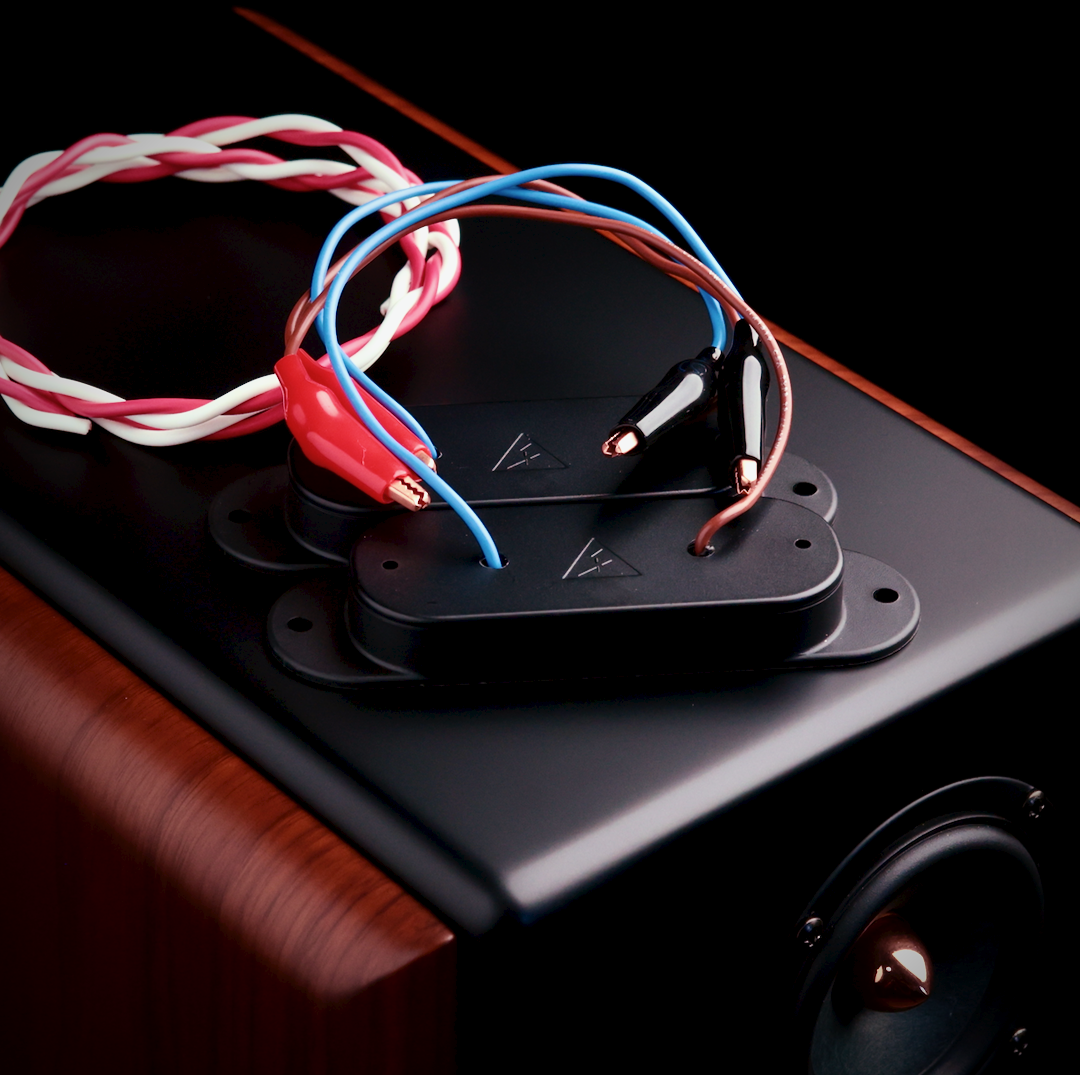
What are those weird-looking binding posts?
Those are tube connectors developed by GR Research. Tube connectors are the highest quality connector available. Compared to traditional binding posts, tube connectors provide high contact area with low-mass. They also allow less material between internal hook up wire and external speaker wire. So insertion losses are kept less than with any other connector. Allie even comes with the male tube connector ends that can be put on your cables. The female tube connectors will except a standard banana plug, but for the sake of signal transfer quality, they are not recommended. For those who want a purpose-built solution, we also offer speaker cables terminated with the correct male tube connectors for a secure and optimized connection.
Is Ron (NRD) profiting from this collaboration?
No. Early on in the design process, Ron made the decision to remove himself from any financial interest in this project. He does not receive compensation or profit from Allie or Maddie sales — all proceeds go to Danny and GR-Research. That decision was important to Ron so he could remain honest with both the product and the audience.
What’s Allie’s return policy?
GR Research is a small, direct-to-customer manufacturer. Each speaker is built and packed individually, and because of the size and shipping costs involved, we are not able to offer a no-questions-asked home trial like large online retailers.
For that reason, we ask customers to order with the intention of ownership rather than short-term auditioning. We work hard to provide detailed measurements, descriptions, and support so you can make an informed decision before purchasing. If you have questions about setup, room compatibility, or amplification, we are happy to help before you place an order.
Our goal is simple: we want every customer who purchases a pair to be confident in their decision and enjoy them for years to come.
3 reviews for Order Allie


Michael T – P00lMan (verified owner) –
GR-Research Allie Speakers — An Owner’s Perspective
I wanted to take a little time to share my experience with the GR-Research Allie speakers because, quite honestly, they have impressed me more than I expected.
I am not a wealthy person, and realistically, speakers costing $10,000, $20,000, or more are simply not in my world. That doesn’t mean I don’t love music or that I don’t appreciate what a really good audio system can do. I truly love music, and over the years I’ve put together the best system I reasonably can within my means.
What I was looking for in a speaker wasn’t necessarily the most expensive or prestigious name. I wanted a speaker that would let me forget about the equipment and simply get lost in the music.
The Allies do that.
What I appreciate most about them is how naturally they bring music into the room. They have an incredible ability to sound open, detailed, dynamic, and alive without making me feel like I’m listening to a collection of drivers and components. There is a sense of presence and realism that makes me want to keep listening to one album after another.
And that’s really the most important thing I can say about them:
The Allies make me want to listen to music.
I don’t have a dedicated listening room. My listening room is my family living room that has to function as a living space first. I don’t have the luxury of designing a room exclusively around audio, with perfect dimensions, acoustic treatment everywhere, and a listening chair positioned precisely in the middle of a dedicated room.
I do have some strategically placed diffusers, furniture, and a few silk plants around the room. I’m also fortunate enough to be able to pull the Allies about 3½ feet out from the front wall. Is that ideal spacing? Probably not.
But the Allies don’t seem to care.
They perform spectacularly in my living room.
I can sit down, put on an album, CD, or stream, and very quickly find myself forgetting that I’m listening to a stereo system. The soundstage opens up, instruments occupy believable positions, vocals have presence, and there is a sense of scale and musical involvement that I didn’t expect at this price.
My audio equipment is pieced together and gently used. I save for something, purchase it, enjoy it, and eventually upgrade when I can. Like any audiophile, I always want what I perceive to be the best. But I enjoy what I have, and it’s paid for.
As Johnny Cash put it, *”I’d get it one piece at a time.”*
That’s pretty much how I’ve built my system.
My current system
-Source: Roon NUC
-CD Transport: Chord BLU MkII
-DAC: Chord DAVE
-Integrated Amplifier: Hegel H600
-Speakers: GR-Research Allies
-Subwoofer: REL Carbon Special
-Speaker Cables: GR-Research 24-strand speaker cables
-Interconnects: AudioQuest Mackenzie XLR
-Digital Cable: Nordost Silver Shadow
-Music Library / Streaming: NAS, Qobuz, and Roon
The digital front end gives the Allies a very revealing signal to work with, and I’ve been genuinely surprised by how well they respond to the quality of the electronics feeding them. They don’t seem to impose a particular sound on the system. Instead, they let the quality and character of the components upstream come through.
But ultimately, none of that matters if the speakers don’t make you want to listen.
These Allie’s do.
I know there are plenty of “name” speakers that cost considerably more, and I’m sure there are people who will always want to spend more chasing the next level of performance. That’s part of this hobby.
But for someone like me, who truly loves music but has a real-world budget, finding a speaker like the Allie is something special.
I don’t feel like I settled for an inexpensive speaker.
I feel like I have a very high-end speaker, and I think that’s what makes the Allies so special to me. GR-Research didn’t make me feel like I had to spend $10,000 or $20,000 to experience what I consider truly high-end sound.
They gave me a speaker that allows me to sit in my family living room, put on music, and just disappear into it for a while.
That’s worth a lot to me.
Thank you, Danny and the entire GR-Research team, for building a speaker that people like me can actually afford and enjoy at this level.
I bought the Allies because I wanted better sound. I kept them because they made me want to listen to more music.
That’s what I was hoping for when I started this journey.
And GR-Research delivered it. At the time of this post, I have 240 hours of listening time on them.
Christian Zambrano (verified owner) –
1-Bring them OUT into your room
2-Allow proper burn in time
3-Be rewarded with depth and ethereal performance
I am so glad to have purchased these speakers after much searching and reviewing. I’m the type who suffers from upgrade.Itis. A well-known and common disease amongst audiophiles.
I must say that these are the first speakers that vaccinated me against that condition. I keep coming back to longer and longer listening sessions, and feel so pleased by how deep and broad the sounds stages and how nuanced vocals come across as REAL ( no added chestiness or bloat). My room is mildly treated, but I have a feeling that these will do very well in the room that is minimally treated as well. I truly enjoy my Allies. The only upgrade that is coming soon will be the Gallion TS 120 SE tube amp I will be happy boy for a very long time.
Richie C –
I love my Allies.
I ordered the red stain variant (Grey Rosewood).
Shipped to me all the way to Australia. Packed really well and arrived safe.
I followed Ron’s LOTS set-up and have the speakers well out into the room. Which ended in an almost near-field configuration in my space. You really do need to get these away from the front wall to get the most out of the Allies. As Danny and Ron strongly suggest.
As Ron may have said in one of his reviews or videos of the Allies, I’ve had good speakers before, including speakers with Danny’s crossover upgrades, but have always felt something was missing or lacking (“something left on the table”). With these, I enjoy a broader spectrum of music than previous speakers. Just about everything I throw at them sound great (full and complete). With previous ‘good’ speakers I’ve had before, maybe the top-end and vocals sound great, but the mid-bass is lacking, or the mid bass is good and have ‘slam’ but the crispy high’s are just not there. Which has previously influenced my listening habits. If it doesn’t sound great on my set-up, I’ll usually skip it and choose something else that sounds awesome (on my current speakers) instead. I don’t want my hifi to influence my listening habits, but it has, in the past.
These speakers sonically cover everything I need to enjoy all my music favourites no matter my differing tastes. Then on top of that there’s the rear firing drivers that give that extra something special to your listening experience.
I’m super pleased with the Allies. I’ve purposely tried to avoid audiophile buzz-words in this review. In short; these are the best speakers I’ve owned and enjoyed at home. They lack nothing, and give me the full spectrum of ‘everything’ that I need to enjoy my music completely. No EQ tweaks or enhancements required (except for good speaker placement).
I’ve integrated a REL sub into my system. A sub is not mandatory with the Allies by any means, but fills out the low bottom-end nicely in my space.